

 Language
 Language
Convenience
One of the most apparent benefits of fast charger is convenience. In today’s fast-paced world, we don’t have the time to wait for hours for our phone to charge. Fast charger enables us to quickly charge our phones and get back to our work or activities without any significant interruption.
Emergency situations
We’ve all been in situations where we need our phone urgently, but the battery is low. Fast charger comes in handy during such emergency situations as it quickly charges your phone, allowing you to use it again. This feature can be a lifesaver during emergencies, where you need to make an urgent call or message.
Saves time
As mentioned earlier, fast charger reduces charging times significantly. With traditional charging methods, it can take hours to charge your phone fully. However, with fast charger, you can charge your phone up to 50% in just 30 minutes. This feature can be beneficial for people who are always on the go and don’t have the time to wait for their phone to charge fully.
Travel-friendly
Fast charger is an essential feature for people who love to travel. When you’re on the move, you don’t have access to charging outlets all the time. Fast charger allows you to quickly charge your phone, giving you the freedom to travel without worrying about your phone’s battery life.
Saves money
Fast charger not only saves time but also saves money. When you charge your phone using traditional methods, it takes a longer time to charge, which consumes more energy. fast charger reduces the charging time, thereby reducing energy consumption, which ultimately saves money.
Better battery health
Contrary to popular belief, fast charger doesn’t harm your phone’s battery health. In fact, it can be beneficial for your phone’s battery life. fast charger uses a high voltage and amperage to charge your phone quickly, which means you don’t have to keep your phone connected to the charger for extended periods. This reduces the heat generated by the battery, which can prolong your phone’s battery life.
Multiple devices
Fast charger is not limited to smartphones; it’s available for other devices such as tablets and laptops. This feature is particularly beneficial for people who use multiple devices and don’t want to spend time charging each device separately. With fast charger, you can quickly charge all your devices and get back to your work or activities without any significant interruption.
USB Type-A charger
The most widespread charger type, USB-A, is the recognisable rectangular connector you find on one end of most charging cables, on computer ports, and in power adapters. Equipped with USB-A to microUSB, USB-A to USB-C, and USB-A to Lightning cables, these chargers ensure compatibility with a wide range of smartphones, laptops, and tablets, regardless of port type. While USB-A chargers are reliable and widely available, they may not offer the fastest charging speeds compared to newer technologies.
01
USB Type-C charger
USB-C is rapidly becoming the universal standard for charging modern devices like smartphones, tablets, and even some laptops. Its reversible connector eliminates fumbling during insertion, while its support for faster charging protocols like USB power delivery and high-speed data transfer makes it a versatile and efficient choice for powering and syncing devices.
02
Fast charger
Fast chargers have revolutionised the way we power our smartphones. Gone are the days of waiting hours for a full charge. With fast-charging technologies like qualcomm quick charge and USB Power Delivery (PD), you can top up your phone’s battery in a fraction of the time.
03
Wireless charger
Wireless chargers offer a convenient, cable-free way to power your devices. They use electromagnetic induction, primarily through the Qi wireless charging standard, to transfer power, eliminating messy cords. While sometimes slower than wired charging, they’re perfect for overnight or desk setups.
04
Portable charger (Power bank)
Portable chargers, also known as power banks, are battery-powered devices that allow you to charge your phone while on the go. These compact and portable chargers come in various capacities, ranging from small pocket-sized models to larger capacity options capable of charging multiple devices multiple times. Portable chargers are ideal for travellers, outdoor enthusiasts, or anyone who needs backup power when access to a power outlet is limited.
05
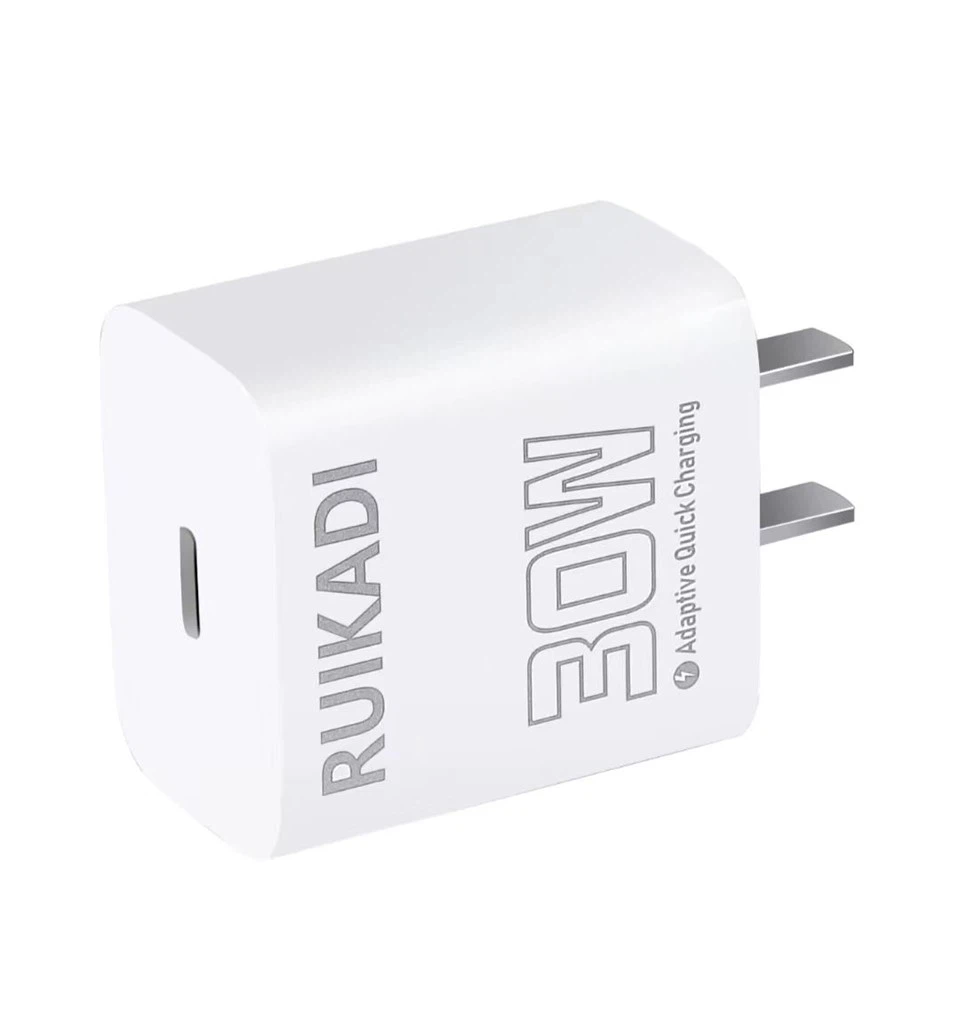
Generally, phone chargers use about 5 watts (W) of electricity. Some faster chargers can use up to 20 W, but the majority of standard chargers are more around the 5 W range. Phone chargers usually use one to two amps and connect to a 120-volt outlet.
How many times you charge your phone has a large impact on how much electricity your phone charger uses. Assuming one full charge takes one hour:
Charging your phone once per day uses 0.035 kilowatt-hours (kWh) of electricity per week, 0.15 kWh per month, and about 1.83 kWh per year.
Charging your phone twice per day uses 0.07 kWh of electricity per week, 0.3 kWh per month, and about 3.65 kWh per year.
While 5 W is a good estimate for the average phone charger wattage, there are also "fast” chargers available for many phone models that pull higher wattages.
The Cable Is Thicker
Fast charging cables are typically thicker since they have more wires clustered inside. However, this is not a hard and fast rule, so identify a fast charger using the other methods mentioned below.
Read the Specs
Most fast charging cables and accessories will state it right on the package, too. Many cable manufacturers will simply label fast chargers and offer a description indicating what it’s capable of. Look for a small description that reads “fast charging.” Another spec detail is “Quick Charge 2.0” or “QC3.0.” Each of these fast charging technologies is slightly different, so be sure to verify what is suitable for your smartphone or device.
Connect Your Device
Another instant way to identify a fast charger is to use it. Unlike a standard charger, a fast charger will indicate it is charging by a lightning bolt in the charging symbol of your device. If it’s not clear, you can also check the battery in the settings and look for “Fast charging.” Of course, this only works with devices that offer fast-charging technology. However, keep in mind that fast wireless charging will still be slower than the average cabled fast charger.
Check the Voltage and Current Output
If you see a cable that puts out power at 5V, 9V, 12V or even 2000mA, this is a sure sign that it’s a fast charger. On the other hand, anything below 1000mAh is considered a slow charger. So look for 5V-2A or 5V-2000mA. Ideally, you should seek out a fast-charging cable of 2A voltage or more, but double-check the specific current suitable to fast charge your personal device.
Charging Protocol Compatibility
When choosing a charger, it's important to consider its compatibility with various devices. Look for chargers that offer universal compatibility, allowing you to charge different devices with ease. And most importantly it should support the charging protocol of your phone
Fast Charging Capabilities
Fast charging is a crucial feature to consider, as it significantly reduces charging time. Ensure that the charger & cable support the fast charging protocol specific to your device to enjoy quicker charging times.
Charging Port Type
The charging port on your charger should match the port on your smartphone. The most common types are USB-C, micro USB, and lightning. USB-C is becoming increasingly popular due to its versatility and faster data transfer speeds. Make sure you choose a charger & cable which have the appropriate port for your phone.
Power Output Compatibility
Check the power output of the charger, usually measured in watts (W). Higher wattage chargers can deliver more power to your phone, resulting in faster charging. Additionally, consider the voltage and ampere ratings mentioned on your smartphone's charger. Quick charging capabilities may vary depending on the phone model, so ensure that the charger supports your device's charging specifications.
Brand Reputation
Opting for chargers from reputable brands is crucial for both safety and reliability. Well-known brands often adhere to strict quality control standards, ensuring a safer charging experience for your device. Research and choose a brand with a good reputation in the market to avoid any potential risks.

Let’s address the most common concern while using a higher-wattage charger for a lower-powered device. The good news is, in most cases, it won’t. Smartphones are designed with in-built safeguards to manage the charging process. If a charger’s power rating worries you, let’s spill the beans – a charger’s power rating has no relation to your phone’s battery lifespan. This is because electricity is not pushed by chargers inside a mobile battery. Instead, it is the smartphone that pulls out the current from the charger, and it will draw only the power it needs. This implies your 20W phone will still charge at its optimal rate, and the excess wattage of the charger won’t decrease the battery’s lifespan.
How Fast Charger Is Different from Regular Charger?
A 5 Watt or 10 Watt charger or a 12W charger is a regular charger as these chargers under their hood have an ordinary, less powerful circuit. A faster charger can improve up to multiple times. It will charge your gadget at a steady speed. Today, it can be declared an obsolete innovation as these chargers now come with a budget smartphone.
However, various technologies empower these fast charging speeds due to the lack of industry-standard around them. One should know that however numerous makers guarantee their product renders fast charging, it might just give the standard 5W supply. Charging occurs in two stages. In the main stage, a higher voltage builds the charging rate. Fast chargers influence this stage to increment power flow. When the battery has acquired most of its charge, the charger will lower the voltage to prevent overheating, guaranteeing your mobile phone and charger are safe.
As of now, over 15 Watts the charger comes in Fast charger categories & it goes up to 95W charger max in India. A fast charger is somewhat heavy & wide when compared with a typical charger. Under their hood, they have a complex and broad circuit. With the assistance of that circuit, the charger controls everything. Fast chargers can charge our gadgets leaving the charging speed subject to watts.
Fast chargers need a thick charging cable since when we plug our gadget into the charger; the charger sends the high power current from the connector to the device with the assistance of a charging cable if the cable isn't thick. So due to a lot of pressure, it may burn or explode, and the slim cable might not be able to deal with it. That is the primary reason why mobile phones & different gadgets with fast charging come with thick cables so that they can undoubtedly manage power & the moving speed.
Raw Materials Preparation The manufacturing process begins with the preparation of raw materials, which include electronic components such as resistors, capacitors, and diodes, as well as plastic and metal components.
Surface Mount Technology (SMT) Process The SMT process involves the placement of electronic components onto a printed circuit board (PCB). This process is automated and involves the use of pick-and-place machines to accurately place components on the PCB. The components are then soldered onto the PCB using a reflow oven.
Through-Hole Assembly Process The through-hole assembly process involves the insertion of electronic components into the pre-drilled holes of the PCB. The components are then soldered onto the PCB using wave soldering machines.
Quality Control After the SMT and through-hole assembly processes are completed, quality control checks are carried out to ensure that the chargers meet the required specifications. This involves testing the chargers for functionality, durability, and safety.
Final Assembly The final assembly process involves the integration of the electronic components with the plastic and metal components. The components are assembled using automated machines or by hand. After final assembly, the chargers undergo another round of quality control checks.
Packaging and Shipping Once the chargers pass the final quality control checks, they are packaged and shipped to customers.
Power Source
One of the key differences between mains chargers and USB chargers is their power source. Mains chargers rely on a wall outlet for power, while USB chargers rely on a USB port for power.
Mains chargers usually have a cord that plugs into a wall outlet and a connector that attaches to the device being charged. They typically provide a higher amount of power and can charge devices more quickly than USB chargers.
USB chargers, on the other hand, can be connected to any device with a USB port, such as a computer, power bank, or car charger. They usually provide less power than mains chargers and may charge devices more slowly as a result.
Charging Speed
Another significant difference between mains chargers and USB chargers is their charging speed. Mains chargers typically charge devices faster than USB chargers.
Mains chargers can provide a higher amount of power, usually ranging from 5 watts to 100 watts, depending on the device being charged. This allows them to charge devices more quickly than USB chargers, which usually provide less power, typically ranging from 2.5 watts to 10 watts.
USB chargers may be sufficient for charging smaller devices such as smartphones or Bluetooth earbuds, but for larger devices such as tablets or laptops, mains chargers are usually faster and more efficient.
Portability
Portability is another important factor to consider when comparing mains chargers and USB chargers. In general, USB chargers tend to be smaller and more portable than mains chargers, while mains chargers are larger and less portable.
Mains chargers typically consist of a large power brick that plugs into a wall outlet, with a cable and connector that attaches to the device being charged. They are often bulky and can be difficult to carry around, making them less portable and more suitable for use at home or in an office.
USB chargers, on the other hand, are much smaller and more compact, making them easier to carry around in a bag or pocket. They can be used with a variety of devices that have a USB port, including smartphones, tablets, and other portable electronics, making them a more versatile option for people who need to charge their devices on the go.
Compatibility
Compatibility is another factor to consider when comparing mains chargers and USB chargers. Mains chargers may not be compatible with all devices, or they may require adapters to work with certain devices.
Mains chargers often have a specific voltage and amperage output, which may not be compatible with all devices. For example, a mains charger designed for use with a smartphone may not provide enough power to charge a tablet or laptop. In such cases, users may need to purchase a different charger or use an adapter to ensure compatibility.
USB chargers, on the other hand, can be used with a wide range of devices that have a USB port, including smartphones, tablets, laptops, and other electronics. This makes them a more versatile option than mains chargers, as they can be used with multiple devices without the need for additional adapters or accessories.
Cost
Cost is another factor to consider when comparing mains chargers and USB chargers. In general, mains chargers tend to be more expensive than USB chargers.
Mains chargers usually have a higher power output and are designed to charge larger devices, such as laptops and other electronics, which can contribute to their higher cost. Additionally, mains chargers may require additional accessories, such as cables and adapters, which can also increase their overall cost.
USB chargers, on the other hand, are generally more affordable than mains chargers. They are often sold at a lower price point and can be purchased from a variety of retailers, including online stores and electronics retailers.
Safety Considerations
Safety is an important consideration when using any type of charger, and there are some key differences to be aware of when comparing mains chargers and USB chargers.
Mains chargers typically have a higher power output than USB chargers and rely on a direct connection to a wall outlet, which can pose a higher risk of electrical shock or fire if not used properly. To minimize these risks, users should always use a mains charger that is designed for their specific device, follow manufacturer instructions for proper use and storage, and avoid using damaged or frayed cords.
USB chargers, on the other hand, typically have built-in safety features that can help prevent overcharging or overheating of the device being charged. These safety features may include thermal protection, over-voltage protection, and short-circuit protection, among others. Some USB chargers may also have certifications from independent organizations, indicating that they have undergone safety testing and meet specific safety standards.


Dayson Electronic Technology Co., LTD., founded in 2004, is mainly engaged in global SMD series electronic components sales and supporting services. Over the years, through the efforts of channel building and consistent integrity to maintain, we have the original factory strong support, for the domestic and foreign electronic companies to provide convenient, perfect, fast sales services. In the industry has been in a leading position.Dayson actively face the market and customer's multi-directional requirements, adhere to the best brand and the most competitive price sales of electronic parts, to provide customers with diversified services, in order to fully meet the requirements of customers, committed to becoming one of the global outstanding SMD component agents.

As one of the leading charger manufacturers and suppliers in China, we warmly welcome you to buy cheap charger for sale here from our factory. All our products are with high quality and low price.
ic yield, electronics wholesale, wireless electronics(0/10)
